

Event
From Intention to Implementation: EELA Joins COP31 Discussion on Delivering Sustainable Energy Technologies at Scale to Advance Energy Efficiency Investments
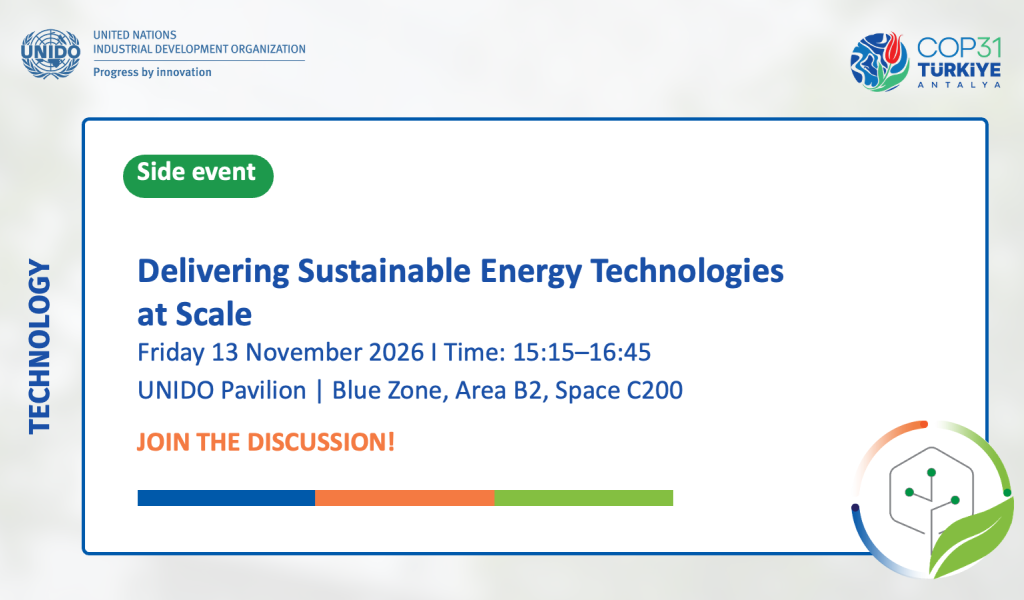
The EELA Program and its experience in advancing industrial energy efficiency will feature in the COP31 discussion “Delivering Sustainable Energy Technologies at Scale”, scheduled on 13 November 2026, from 15:15 to 16:45 at the UNIDO Pavilion. The session will focus on a central question: what delivery models are needed to connect industrial demand, sustainable energy technologies and finance, and turn climate ambition into investment and implementation?
THE SUSTAINABLE ENERGY INVESTMENT MISMATCH IN EMERGING AND DEVELOPING ECONOMIES
As emerging and developing economies industrialize, the challenge is not only to meet growing energy demand, but to ensure that energy can be used efficiently, reliably and competitively to support productive growth. For industries, access to high-performing, energy-efficient technologies can lower operating costs, improve productivity and resilience, and strengthen competitiveness, while supporting progress towards climate objectives.
Yet investment is failing to keep pace with this opportunity. More than 80 per cent of recent global energy-demand growth has come from Global South countries, while more than 90 per cent of clean-energy investment since 2021 has been concentrated in advanced economies and China. Global investment in energy efficiency across buildings, industry and transport increased by only 3 per cent to USD 346 billion in 2024.
For many industries, the challenge goes beyond access to finance. Businesses can struggle to translate energy audits and identified opportunities into bankable projects due to limited technical capacity, weak project preparation and difficulties accessing suitable financing and credible technology providers. Supply-chain constraints, foreign-exchange pressures and long technology lead times can further delay investment.
MOVING FROM CLIMATE AMBITION TO INDUSTRIAL IMPLEMENTATION
Against this backdrop, the UNIDO session will explore how practical delivery models can help bridge the gap between climate ambition and industrial implementation, drawing on experiences and approaches including the Global Green Industrialization Agenda (GGIA), the EELA Program and the Industry Clean-Tech Platform (ICTP).
Rather than looking at technologies or finance in isolation, the discussion will bring together perspectives from across the industrial energy-efficiency ecosystem to consider what is needed to bring sustainable energy technologies to industries at scale.
The session will explore how stronger partnerships and new approaches to industrial energy-efficiency investment can help overcome persistent barriers and create the conditions for implementation, particularly in emerging and developing economies.
A PRACTICAL DELIVERY MODEL FOR INDUSTRIAL CLEAN TECHNOLOGIES
The discussion will bring together perspectives from African governments, UNIDO, Sweden, technology and energy-efficiency specialists, and financing institutions, moving beyond the identification of barriers to examine what can be done differently to unlock implementation at scale.
Drawing on practical experiences, including those emerging from EELA and the ICTP, the session will explore opportunities for collaboration between governments, development partners, technology providers, industries and financing institutions, and consider how these partnerships can contribute to the next generation of industrial energy-efficiency investments.
Join the discussion at COP31 to explore what it takes to move from intention to implementation.
13 November 2026 | 15:15–16:45 | UNIDO Pavilion, COP31
AGENDA
|
15:15 – 15:25 |
Welcome Remarks |
Ms Ulrika Åkesson, Deputy Director, Department for Results, Swedish International Development Cooperation Agency (Sida) |
|
15:25 – 15:35 |
Opening Remarks
|
Mr Eng Dr Isaak Kiva, Secretary for Renewable Energy, Ministry of Energy Kenya |
|
15:35 – 15:55 |
Keynote Presentation “The hidden potential of delivery models supporting green industrialization and just energy transitions” |
Mr Dr Christopher Hope, Energy Transition Specialist, UNIDO |
|
15:55 – 16:30 |
Panel “Translating climate ambition to implementation action by unlocking financing at scale for industrial energy technology deployment” |
Mr Eng Arnold Simwaba, Permanent Secretary Electricity. Ministry of Energy Zambia Mr Babagana Bukar, Director of Planning, Research and Statistics, Federal Ministry of Environment Nigeria Ms Verena Adamheit, Senior Business Development International Markets, Swedish Energy Agency Mr Pontus Davidsson, Head of Origination & Strategic Partnerships, Swedish Export Credit (SEK) Agency Ms Stéphanie Nour, International Director, Econoler |
|
16:30 – 16:40 |
Questions & Answers |
|
|
16:40 – 16:45 |
Conclusions |
|