
News
From Strategy to Implementation: EELA PSC Sets Priorities for Scaled Impact
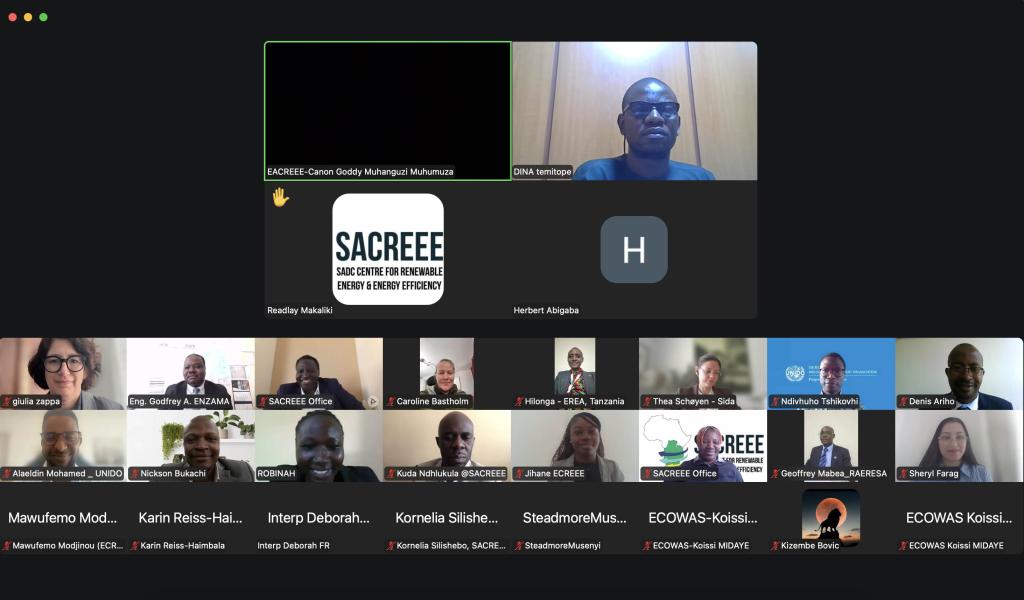
On April 23, 2026, the EELA Regional Project convened its third Project Steering Committee (PSC) meeting bringing together representatives from regional economic communities, national institutions, development partners and technical experts. The meeting, which was held virtually, aimed to review progress since the last PSC, assess strategic alignment with evolving regional and global agendas, and provide guidance to ensure the programme delivers measurable, implementable impact across Africa.
STRATEGIC OPENING REMARKS: ENERGY EFFICIENCY AS A DEVELOPMENT ENABLER
Opening the meeting, the Chair, Eng. Herbert Abigaba, Assistant Commissioner for Renewable Energy at Uganda’s Ministry of Energy and Mineral Development, representing Dr. Brian E. Isabirye, formally adopted the agenda and set a clear tone for the discussions. He underscored energy efficiency as a cornerstone of sustainable development, industrial competitiveness and climate resilience across African regions. “Energy efficiency remains one of the most cost‑effective pathways to support sustainable livelihoods, industrial growth and climate resilience,” he noted, calling on PSC members to provide forward‑looking governance and practical guidance to support implementation on the ground. The Co‑Chair, Eng. Dina Temitope, reinforced this message, stressing the importance of continuity, strong partnerships and translating policy frameworks into tangible results that can be reported at national and ministerial level.
STRONG DONOR COMMITMENT AND GLOBAL POSITIONING
Speaking on behalf of the Swedish International Development Cooperation Agency (Sida), Ms. Thea Schøyen, incoming responsible programme officer, reaffirmed Sida’s long‑standing commitment to energy efficiency and sustainable energy, noting Sida’s support to EELA since 2019. “It is encouraging to see how EELA has grown into a truly continental programme,” she said, welcoming both the expansion across ECOWAS, SADC and EAC and the recently signed agreement to explore an extension to the Middle East and North Africa region. Ms. Caroline Bastholm, outgoing Sida programme officer, thanked partners for the strong collaboration to date, expressing confidence in EELA’s ability to continue delivering impact through strategic regional cooperation.
CONNECTING ENERGY EFFICIENCY TO GLOBAL AGENDAS AND INVESTMENT
A key strategic intervention was delivered by the EELA Program Manager Ms. Karin Reiss-Haimbala (UNIDO), who positioned EELA within broader global, continental and institutional dynamics. She highlighted the rising prominence of energy efficiency amid shifting development cooperation landscapes and underscored Sida’s continued trust as a clear signal of EELA’s credibility and impact orientation. Reiss-Haimbala linked EELA’s work to major international developments such as the Bélem Declaration on Green Industrialization and outcomes of the G20 Energy Transition Working Group, noting strong synergies with the emerging G20 energy efficiency legacy programme led by South Africa. “EELA is well embedded in UNIDO’s reinforced mandate on the energy–industry nexus,” she stated, emphasizing opportunities to link policy and technical assistance with investment pipelines, industry cleantech platforms and climate finance instruments. She further highlighted the programme’s potential contribution to regional economic and clean energy corridors, and encouraged countries to leverage opportunities under the GEF, Green Climate Fund readiness window and the Adaptation Fund to scale national energy efficiency actions.
PROGRAMME PROGRESS AND STRATEGIC IMPLEMENTATION
The EELA Project Management Unit (PMU) presented a consolidated update on progress across programme outcomes, including regional policy harmonisation, minimum energy performance standards (MEPS), testing and labeling systems, private sector engagement, national compliance support, communication and visibility, and budget execution. The presentation served as a strategic basis for PSC guidance, with a strong focus on moving from frameworks to implementation at scale.
INDUSTRIAL MOTORS: UNLOCKING MAJOR ENERGY AND COST SAVINGS
A dedicated session, presented by Chemonics Egypt Consultants, focused on industrial motors, a strategic area given their dominant share in industrial electricity consumption. The assessment highlighted the significant energy and cost‑saving potential of transitioning to higher‑efficiency motor classes across African industries. Discussions emphasised the need for tailored financing solutions, awareness‑raising among industrial users, and a systems‑level approach that goes beyond individual components.
PSC members welcomed the progress achieved while discussing challenges related to national adoption processes and enforcement of standards. The discussions confirmed strong alignment among partners on EELA’s strategic direction, with members reaffirming their commitment to accelerate implementation and translate regional frameworks into measurable results at national level. The Chair closed the meeting by thanking participants for their active engagement and confirmed that the next PSC meeting will be held in person, reinforcing EELA’s commitment to deepened collaboration and accelerated impact across Africa.